
OUR EDITORIAL STANDARDS
Useful content starts with clear responsibility.
How we choose topics, handle sources, use AI assistance and keep commercial relationships visible.
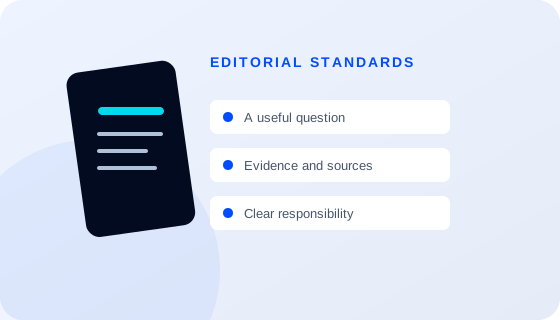

Reader-first scope
Start with a useful question and a defined outcome.

Evidence with context
Distinguish sources, examples and observed results.

Visible responsibility
Name authors and disclose commercial relationships.
ON THIS PAGE
01
Choose topics around a reader’s task
We prioritise practical questions for marketers, agency owners, founders, and small business teams. An article should explain a concept, support a decision, or help a reader complete a task. We avoid publishing a page only because a keyword or sponsor makes it commercially attractive.
02
Match each claim to its evidence
We prefer primary sources such as official documentation, original research, and first-hand material. We distinguish a product feature reported by its vendor from a feature we have checked ourselves. Constructed examples and illustrative numbers must be labelled. A checklist is a framework, not proof of a result.
03
Use AI with clear responsibility
AI tools may assist planning, research organisation, drafting, or editing. They do not replace responsibility for the final article. Factual claims need checking, sources must exist, and first-hand experience must not be invented. Contributor work must add the writer’s own experience and evidence.
04
Keep commercial work separate
Sponsored content is labelled above the article and on its cards. Paid links are marked sponsored. An affiliate relationship is disclosed when it applies. Payment cannot purchase a positive verdict or a place in an independent ranking. Read our disclosure policy.
05
Make dates meaningful
An article’s updated date changes when its substance changes. We explain significant revisions in a “What changed” note. Product prices, plan limits, and availability need a dated check. We revisit time-sensitive guidance when we learn that its details have changed.
06
Corrections
To report an error, use the contact form and include the article URL, the statement at issue, and a reliable source or explanation. We aim to acknowledge editorial enquiries within 7 working days. Material corrections are noted on the article; minor spelling fixes may be made without a separate note.
07
Authorship and contributions
Articles use a real author’s name and a profile describing relevant expertise. We do not use stock portraits as author photos. A second reviewer is named only when that person has actually reviewed the work. Read the contributor guidelines before pitching.
YOUR NEXT STEP
Help us keep the record accurate.
For a correction, include the article URL, the statement at issue and a reliable source or explanation.